
OnlyFans Fan Segmentation: New Fans, Spenders, VIPs and Inactive Subscribers
Segment OnlyFans fans by lifecycle, spend, and intent so every message, offer, and follow-up matches the right audience.

Fan segmentation is what turns an overcrowded OnlyFans inbox into a controlled revenue system. If you separate new fans, active spenders, VIPs, and inactive subscribers, every message becomes easier to write, route, and measure. The point is not to build a complicated database. The point is to make the next action obvious.
For agencies, segmentation is the difference between scattered chatter and a repeatable workflow. It helps you decide who should see a welcome sequence, who should receive a PPV offer, who needs a human owner, and who should get a carefully timed reactivation message. It also makes your team’s use of welcome messages, PPV pricing, and chatter scripts far more consistent.
Key Takeaways
- Segment by behavior first. Recency, spend, reply speed, and conversation depth are more useful than gut feeling.
- New fans need orientation. Spenders need relevance. VIPs need speed and memory. Inactive subscribers need a calm return path.
- One message should have one job. If you ask every segment to do the same thing, you waste attention and depress conversion.
- A simple routing rule beats a perfect taxonomy. Clear ownership and a next step matter more than fancy labels.
- Substy is most useful when segmentation flows into CRM tags, fan memory, triggers, and scheduling.
What fan segmentation actually means
Segmentation is the discipline of grouping fans by what they have done, what they are likely to do next, and how quickly your team should respond. On a busy page, that matters more than almost any other inbox habit. Without segments, your best copy and your best offers end up competing with each other. With segments, every touchpoint is more specific.
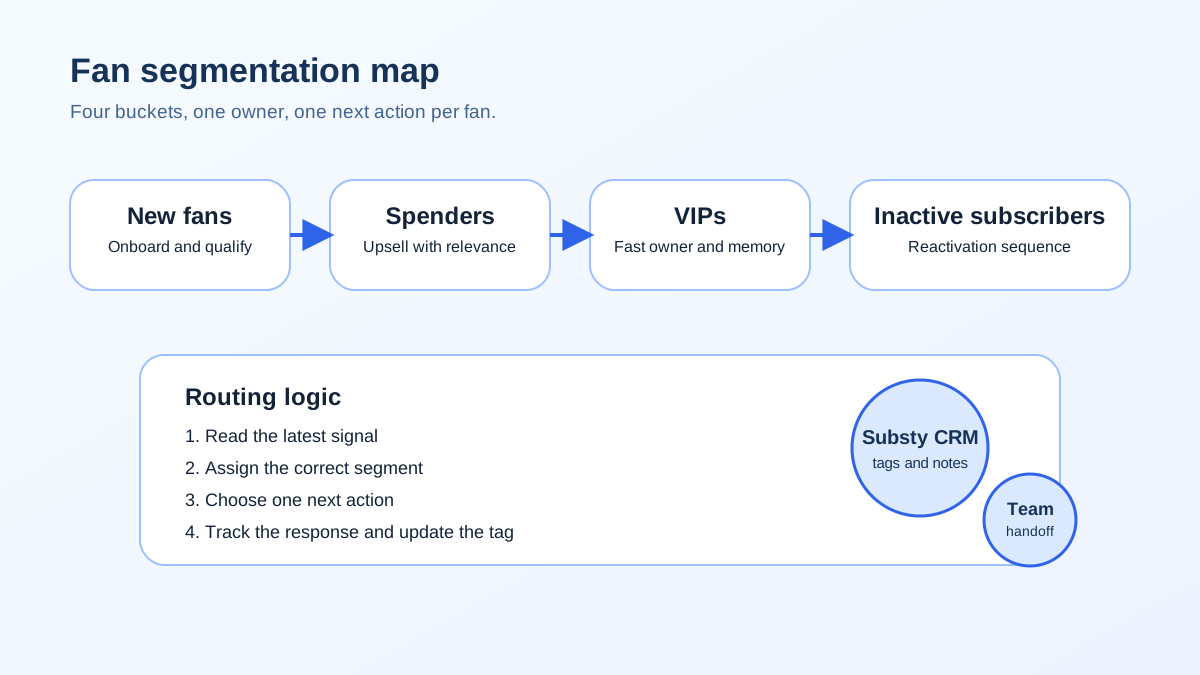
The most practical system is also the simplest. Start with four buckets: new fans, active spenders, VIPs, and inactive subscribers. Those groups cover the majority of the decisions an agency makes every day. They also map cleanly to retention planning, subscription pricing, and the way your chatter team handles follow-up across multiple accounts.
New fans
New fans are still deciding whether the page is worth their time. They need clarity, proof of value, and a low-friction next step. A new fan should not be treated like a loyal spender. They need a short welcome sequence, a sense of what happens next, and enough context to feel safe continuing the conversation.
Active spenders
Active spenders already trust the page enough to buy. That trust is fragile if you send generic offers or repeat the same pitch too often. This group responds best to relevant upsells, better timing, and messages that show you understand what they already enjoy.
VIPs
VIPs are the fans whose behavior justifies faster response times, tighter notes, and more human oversight. The value of a VIP is not only the amount spent. It is also the consistency of their interest, the speed of their replies, and the quality of the relationship you have already built. A VIP should never feel like a random broadcast target.
Inactive subscribers
Inactive subscribers are not lost until you stop speaking to them in a structured way. Some are cooling off. Some are distracted. Some are waiting for a reason to return. They need a different tone from active spenders because the goal is not to push harder. The goal is to re-open a conversation without creating friction.
A practical segmentation framework
Use a four-step framework that can run in a spreadsheet, a CRM, or a creator management platform. The names matter less than the logic. Every fan should move through the same sequence: identify the signal, assign the segment, define the next action, and measure whether the action worked.
Step 1: Identify the strongest signal
Pick the signal that best predicts the next message. For a new fan, that may be first purchase or first reply. For an active spender, it may be unlock frequency or repeat engagement. For a VIP, it may be conversation depth and a pattern of custom requests. For an inactive subscriber, it may be the date of the last response.
Step 2: Assign one owner
Every segment should have one accountable owner. That can be a creator, a senior chatter, or a team lead. If two people think they own the same fan, nobody really owns the next move. This is where multi-account management becomes important, especially when several creators share the same team.
Step 3: Define the next action
The next action should be specific. For new fans, it may be a welcome note or a first light offer. For spenders, it may be a higher-value PPV or a more personal message. For VIPs, it may be a fast 1:1 reply or a custom request. For inactive subscribers, it may be a reactivation sequence with a softer tone.
Step 4: Review the result
Do not judge the segment by a single message. Judge it by the behavior that follows. Did the fan reply? Did they unlock? Did they go quiet again? Did they move up or down a tier? Segmentation is only useful if it improves the next decision.
Segment-by-segment playbook
| Segment | What usually signals it | Primary goal | Best next move |
|---|---|---|---|
| New fans | First follow-up, limited history, early curiosity | Build confidence and direction | Send a short welcome, set expectations, and ask one easy question |
| Active spenders | Recent unlocks, steady replies, willingness to buy | Increase average order value without fatigue | Offer a relevant PPV, custom path, or higher-value continuation |
| VIPs | Repeated high-value purchases, custom asks, fast replies | Protect the relationship and reduce response time | Route to the best owner, use memory, and avoid generic blasts |
| Inactive subscribers | Long silence, no recent unlocks, low engagement | Restart dialogue without pressure | Send a calm reactivation sequence and stop if the fan is not receptive |
How to keep segment labels honest
Segments drift when teams stop refreshing them. A fan who looked like a new fan last week may already be a spender this week. A quiet fan may be inactive, or they may simply be waiting for a different offer. The safest way to avoid bad routing is to review labels after each meaningful action instead of assuming the last tag is still true.
In practice, that means checking three things every time the inbox changes. First, did the fan reply? Second, did the fan buy? Third, did the fan’s pace change enough to justify a new label? If the answer to any of those questions is yes, the segment should probably move. That keeps your workflow accurate and stops stale tags from shaping the next message.
- Remove labels that no longer predict the next move.
- Promote fans when their spending or reply pattern changes.
- Do not let one old tag override fresh behavior.
- Review VIP status regularly so the best fans never sit in the wrong queue.
That discipline matters because the best segmentation systems are not static. They are living routing tools that change when fan behavior changes. The more often your team refreshes them, the less likely you are to send the wrong offer to the wrong person.
Real-world examples
Example 1: A new fan subscribes, opens one message, and does nothing else. That fan should get a brief welcome, not a long sales pitch. The goal is to reduce uncertainty before you ask for any purchase.
Example 2: A fan buys one low-priced PPV every few days. That is an active spender, not a VIP. Your next move should be a relevant continuation, not a larger ask that comes too early.
Example 3: A fan sends long replies, tips multiple times, and asks about custom content. This is the time to route the conversation to a stronger owner and keep notes visible. A high-value fan is lost quickly when the handoff is sloppy.
Example 4: A fan disappears after a month of activity. Do not assume the relationship is dead. Treat the next message as a restart, not a recovery mission. The tone should be simple, respectful, and low-pressure.
Checklist before you route a fan
- Did you confirm the fan’s most recent action before sending anything?
- Does the segment have one clear owner?
- Is the next message tied to a single goal?
- Are you avoiding the same offer for every group?
- Have you logged the result so the next message can improve?
How Substy helps agencies segment fans
Substy is useful when segmentation has to survive real team traffic. A CRM view keeps the fan history visible, fan memory helps the team avoid repetitive questions, and analytics show which segments actually respond. Triggers and scheduling can move a fan into the right sequence at the right time, while team management keeps everyone working from the same playbook.
That matters even more if you manage multiple creators. One account may need a stronger welcome flow, another may need a more aggressive reactivation path, and a third may need tighter VIP handling. Substy gives you one place to standardize those rules without flattening every creator into the same routine. If you also rely on AI chat setup or chatbot policy guidance, segmentation gives you the guardrails you need to keep automation useful instead of noisy.
If you want segment tags, fan memory, and routing rules to live in one workflow, open Substy and keep the whole team on the same page.
FAQ
Build segmentation into the workflow
Good segmentation is not a theory document. It is a daily operating rule. When every fan gets the right next step, your page becomes easier to manage and your team wastes less time on the wrong conversations.

Start with recency, spend, and response speed. Labels only help when they point to a next action.
One fan, one owner, one next step. That reduces overlap, delays, and inconsistent offers.