OnlyFans Content Calendar — How to Plan Your Posts for Maximum Revenue
The complete guide to building an OnlyFans content calendar in 2026 — weekly rhythms, monthly planning, coordinating content with PPV campaigns, and how agencies manage posting schedules.
Most OnlyFans creators post when they have something ready. The ones generating the most consistent revenue operate differently — they plan content in advance, coordinate posting with fan messaging campaigns, and treat their content calendar as a revenue tool rather than a simple schedule.
This guide covers how to build an OnlyFans content calendar that actually drives revenue.
Why a Content Calendar Is a Revenue Tool
The difference between a posting schedule and a content calendar is strategy. A posting schedule tells you when to post. A content calendar tells you what to post, in what sequence, coordinated with what fan messaging, to produce the most conversion.
Content planned in sequence creates momentum. A free teaser posted Monday creates desire for a PPV that drops Wednesday. A mass message sent Thursday referencing content fans already saw converts at a higher rate than a message for content fans have never encountered. Agencies that coordinate content and messaging calendars consistently outperform those treating them as independent functions. The PPV strategy that makes this coordination most effective is covered in the PPV strategy guide.
The Four Content Types to Plan Around
A functional OnlyFans content calendar distributes four distinct content types across the week, each serving a different role in the revenue cycle.
Free feed content is the visible baseline all subscribers see. Its job is to demonstrate value, maintain engagement, and create desire for premium content. Free feed posts should be sequenced to build toward PPV launches rather than sitting as isolated pieces with no relationship to what follows.
PPV content is where the majority of non-subscription revenue is generated. Planning PPV drops in advance allows surrounding free content and messages to build anticipation rather than arriving without context. A PPV that lands after two days of related teaser content consistently converts better than a surprise drop.
Mass messages are direct communications to the subscriber list, typically tied to a PPV launch or a re-engagement campaign. They should be planned in the calendar alongside the content they reference so that the messaging and the content work together rather than independently.
Story content creates real-time touchpoints that reinforce personal connection. Stories benefit from reserved slots in the weekly structure to ensure the habit is maintained, while remaining flexible enough to feel spontaneous to subscribers.
Building the Weekly Content Rhythm
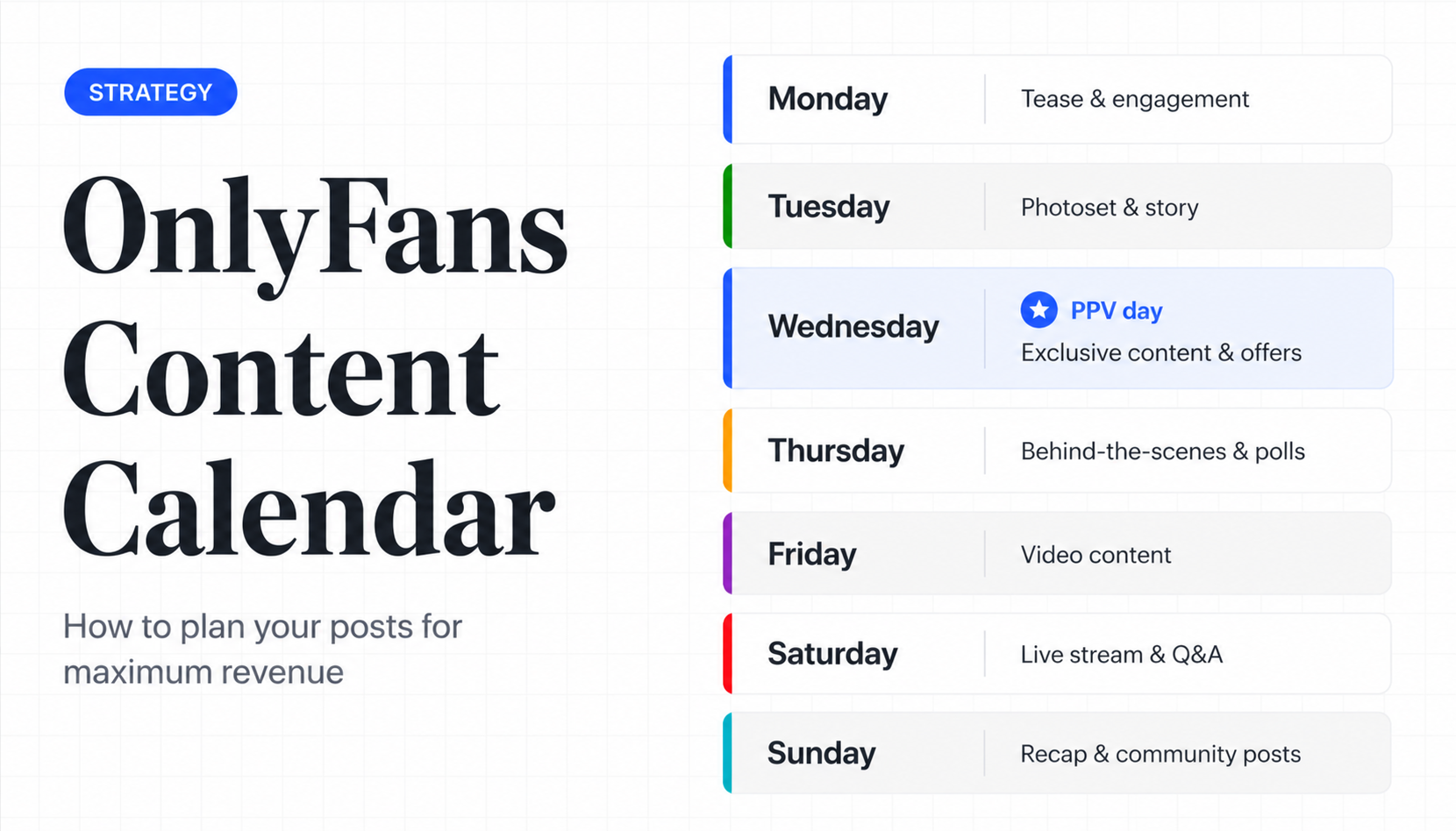
The most practical approach is a recurring weekly template that gets populated with specific content during a brief planning session at the start of each week. This gives the operation predictable structure without requiring every post to be spontaneous.
A working weekly rhythm for an established creator might look like this: free feed posts on Monday, Wednesday, and Friday to keep subscriber engagement consistent; a PPV drop on Tuesday or Thursday when platform activity tends to be higher; a coordinated mass message on the same day as the PPV; and story content used naturally throughout the week. This rhythm is a default structure that can flex for seasonal moments, launches, or promotional pushes without losing its underlying logic.
For agencies managing multiple creators, the template approach is essential. Each creator has their own weekly template with their content categories and posting frequency defined. The agency's job is to populate each template with creator-specific content each week, not to build a new calendar from scratch each time.
Monthly Planning — The Macro Calendar
Beyond the weekly rhythm, a monthly planning session sets the larger content arcs that give the weekly calendar its direction. Monthly planning is where major PPV content launches get scheduled, where promotional pushes are placed on the calendar, where collaboration and shoutout opportunities are identified, and where thematic content series get mapped out.
A monthly plan might identify that Week 2 is a major PPV launch week, requiring the surrounding free content in Week 1 to build anticipation for it. It might identify that a seasonal moment or holiday in Week 3 creates a natural content opportunity. It might note that a planned collaboration needs content prepared in Week 4 to support it.
This macro view prevents the common problem of reactive content production — where creators are always planning for the immediate week and never building the momentum that comes from content designed to work together across a longer horizon.
Content Planning for AI-Managed Accounts
For agencies running AI chatbot automation, the content calendar has an additional dimension: coordinating the AI's messaging schedule with the content calendar. The AI doesn't need to know that a specific piece of content is dropping on Wednesday unless it's been configured to send related messages on Tuesday evening to prime interested fans.
This coordination — between the content calendar, the AI messaging configuration, and the human team's VIP management schedule — is what separates agencies running their operation as an integrated system from those where each function operates independently. The AI chatbot framework that makes this coordination automatic is covered in the AI playbook for OnlyFans agencies.
Posting Frequency by Creator Type
There is no single right posting frequency for OnlyFans. The optimal frequency depends on the creator's content type, production capacity, and the subscription price they're charging. A creator charging $15 a month should post more frequently than one charging $5, because the higher price creates a stronger expectation of consistent value delivery.
As a general framework, creators posting three to five pieces of content per week on the main feed, with one to two PPV drops per week and regular mass messages, tend to generate the best combination of subscriber retention and PPV revenue. Below two pieces of free content per week, subscriber churn typically increases as fans feel the page isn't active. Above seven pieces per week, production quality often suffers and the marginal content adds diminishing returns.
For agencies managing multiple creators, the frequency should be set based on each creator's realistic production capacity rather than an arbitrary target. An ambitious posting schedule that results in rushed, low-quality content is worse than a modest schedule executed with consistent quality. The subscriber retention impact of consistent quality is covered in the retention guide.
Content Calendar Tools and Systems
The tool used to manage a content calendar matters less than the system behind it. A well-structured spreadsheet used consistently outperforms a sophisticated scheduling tool used sporadically.
The key features any content calendar system needs are a clear view of the upcoming week's planned content by type, the ability to see how content and messaging align on any given day, and a record of what was posted when for performance review. Most agencies find that a simple shared document or spreadsheet per creator, reviewed weekly, is more practical than dedicated content planning software for the specific demands of OnlyFans management.
What the calendar system does not replace is the fan management and analytics layer that evaluates how the content strategy is performing. Knowing that a specific PPV content type converts at 14% versus another at 6% informs future content planning in a way no scheduling tool can provide. That intelligence comes from a CRM with proper content performance tracking, as covered in the metrics guide.
FAQ - OnlyFans Content Calendar
How often should you post on OnlyFans ?
Three to five pieces of free feed content per week is a strong baseline for most creators. Below two pieces per week, subscriber churn tends to increase. The right frequency depends on content type, subscription price, and production capacity. Consistency matters more than volume — a reliable three-posts-per-week schedule outperforms an inconsistent seven-posts-per-week schedule.
What is the best time to post on OnlyFans ?
OnlyFans activity generally peaks in the evening hours across the creator's primary audience time zone. For US-based audiences, this means late afternoon to late evening Eastern time. For agencies with analytics tracking, reviewing subscriber activity patterns per account and posting during those windows produces better engagement than posting at arbitrary times.
How do I plan OnlyFans content in advance ?
Start with a monthly macro plan that identifies major PPV launches, promotions, and thematic arcs. Then build a weekly template that defines how many posts of each content type go out and on which days. Populate the weekly template with specific content each week during a brief planning session, coordinating posting dates with the fan messaging schedule for that week.
How do I coordinate OnlyFans content with PPV campaigns ?
Plan your PPV drop date first, then work backward to create two to three days of teaser content that builds anticipation for it. Schedule the mass message send for the same day as the PPV drop, referencing the content fans have been following. This coordination consistently produces better PPV conversion than standalone drops.
Do agencies use content calendars for OnlyFans ?
Yes, professional agencies typically use creator-specific content calendars that coordinate posting schedules with PPV launch dates, mass message campaigns, and traffic generation activity. Agencies managing multiple creators need a systematic approach to content planning to maintain quality and consistency across the roster.
The Bottom Line
A content calendar is the operational tool that turns content creation effort into consistent, compounding revenue. Without it, content production is reactive and the connection between content and fan messaging is left to chance. With it, every piece of content serves a defined purpose in the revenue cycle and the messaging operation amplifies rather than operates independently from what's being posted.
The content calendar works best when it's connected to the analytics that show what's converting. Substy provides the fan management and performance tracking that closes the loop — connecting content performance to fan behavior data so that future content planning is based on what actually drives revenue for each specific creator's audience.