
OnlyFans Taxes — The Complete Guide for Creators and Agencies in 2026
The complete OnlyFans tax guide for creators and agencies in 2026 — what's taxable, quarterly payments, deductible expenses, and how to handle taxes professionally from day one.
OnlyFans generates real income, and real income means real tax obligations. Yet taxes are one of the most consistently neglected areas in the creator economy, partly because the platform doesn't withhold anything and partly because many creators start making money before they've thought through the business side of what they're doing.
This guide covers the core tax principles that apply to OnlyFans creators and agencies, what you need to track, and how to approach it like a professional business rather than a side hustle that you'll sort out later.
Is OnlyFans Income Taxable ?
Yes, completely. Every dollar earned through OnlyFans — subscription revenue, PPV unlocks, tips, custom content payments — is taxable income. This applies whether you're a creator earning $500 a month or an agency generating $50,000 a month. The IRS and tax authorities in other countries treat creator economy income the same as any other self-employment or business income.
OnlyFans does not withhold income tax. The platform pays out gross earnings, and it's entirely the creator's responsibility to set aside taxes and pay them appropriately. For creators in the United States, this means both income tax and self-employment tax (which covers Social Security and Medicare contributions that employers would normally withhold). The self-employment tax rate is 15.3% on net self-employment income, on top of regular income tax rates.
This combination catches many creators off guard. Someone earning $3,000 a month from OnlyFans who hasn't been setting aside taxes may owe $8,000 to $12,000+ at the end of the year, depending on their total income and deductions. The surprise is avoidable with basic planning from the start.
How OnlyFans Reports Income
In the United States, OnlyFans issues a Form 1099-NEC to creators who earn $600 or more in a calendar year. This form reports total earnings paid to the creator and is also filed with the IRS, which means the IRS has a record of the income regardless of whether the creator reports it. Not reporting OnlyFans income that has been 1099'd is not a gray area — it's tax evasion.
Creators earning under $600 in a calendar year may not receive a 1099, but the income is still taxable. The $600 threshold affects reporting requirements, not taxability.
For creators outside the United States, OnlyFans may collect tax forms (typically a W-8BEN for non-US persons) and may withhold a percentage of payments depending on tax treaty status between the creator's country and the US. Non-US creators should verify their withholding status and understand how their home country treats foreign-source income.
Quarterly Estimated Tax Payments
Self-employed individuals in the United States are generally required to make quarterly estimated tax payments if they expect to owe $1,000 or more in federal taxes for the year. The quarterly deadlines are typically in April, June, September, and January.
Failing to make quarterly payments can result in underpayment penalties, even if you pay the full amount owed when you file. The penalty is not large, but it's avoidable. The simplest approach is to set aside 25% to 30% of every OnlyFans payment received into a dedicated savings account and make quarterly payments from that account.
The exact percentage to set aside depends on total income, filing status, and other factors. Creators at the lower end of earnings may need to set aside less. Those in higher income brackets or with other income sources may need more. A brief consultation with a tax professional at the start of each year is the most reliable way to calibrate the right percentage.
Deductible Business Expenses for OnlyFans Creators
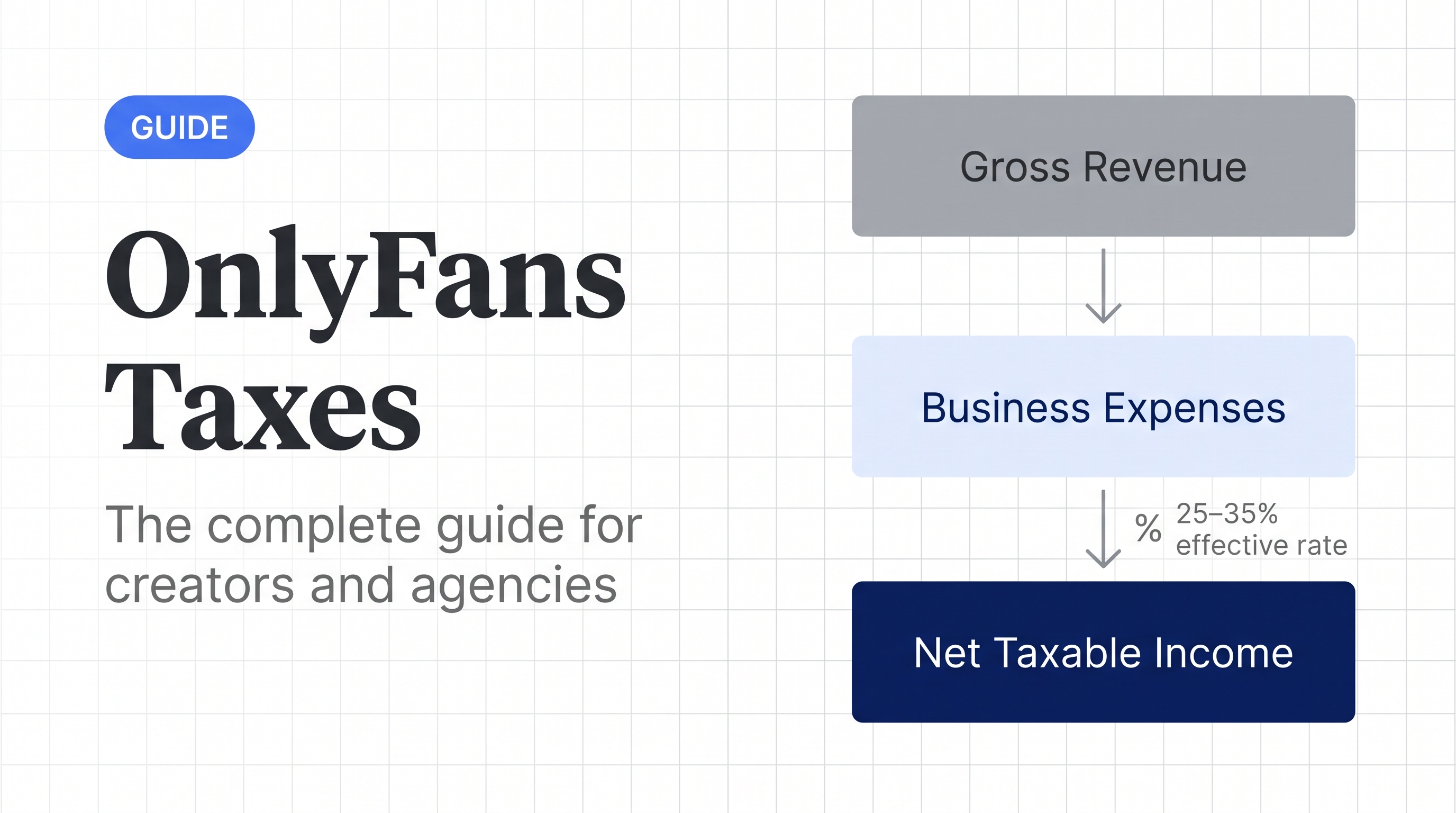
The most important tax concept for OnlyFans creators to understand is that business expenses reduce taxable income. The tax obligation isn't on gross revenue — it's on net profit after legitimate business expenses are deducted. This distinction significantly affects how much tax is actually owed.
Equipment and technology are deductible. Cameras, lighting, tripods, computers, phones used primarily for the business, ring lights, and any other equipment purchased for content creation is deductible as a business expense. These can typically be deducted in full in the year of purchase under IRS Section 179, rather than depreciated over multiple years.
Platform and software costs are deductible. OnlyFans charges a 20% platform fee on all earnings — this is a business cost and reduces net income accordingly. CRM platforms, AI chatbot subscriptions, scheduling tools, and other software used to run the OnlyFans operation are fully deductible. The monthly cost of platforms like Substy for fan management and AI chatting is a business expense that reduces taxable income dollar for dollar.
Home office deduction applies if a portion of the home is used regularly and exclusively for the business. The IRS allows a simplified home office deduction of $5 per square foot up to 300 square feet, or a more complex calculation based on the percentage of the home used for business. For creators who shoot content and manage their business from home, this deduction can be meaningful.
Content creation costs are deductible. Costumes, props, sets, makeup, wigs, and any physical items purchased specifically for content creation are deductible business expenses. Clothing can be deducted only if it's not suitable for everyday wear — a specific costume purchased for content qualifies, but general clothing typically doesn't.
Marketing and promotion expenses are deductible. Paid shoutouts, advertising spend, software used for tracking and analytics, and any other expenses directly related to promoting the OnlyFans account are deductible business costs.
Professional services are deductible. Accounting fees, legal fees for reviewing creator contracts, and any other professional services engaged for the business are fully deductible.
Tax Considerations for OnlyFans Agencies
For agencies managing multiple creator accounts, the tax picture is more complex than for individual creators, but the core principles are the same. Agency revenue — the revenue share collected from managed creators — is business income subject to income tax and, depending on the business structure, self-employment tax or corporate tax.
Business structure matters significantly for agencies. A sole proprietor operating as an OFM agency pays self-employment tax on all net profits. An agency structured as an LLC or S-Corp may have options to reduce the self-employment tax burden by separating salary from distributions, though this requires professional guidance to execute correctly. The tax benefits of forming a formal business entity become more meaningful as revenue grows.
Chatter labor costs are deductible business expenses. Whether chatters are employed or contracted, their compensation is a business cost that reduces taxable profit. If chatters are paid as independent contractors earning over $600 in a calendar year, the agency is required to issue them a Form 1099-NEC.
Software and platform costs for the agency operation — CRM, AI chatbot, analytics tools, tracking link platforms — are fully deductible. The complete agency tooling investment described in the OnlyFans software guide represents deductible business expenses that reduce net taxable income.
Record Keeping for OnlyFans Income
The single most important tax habit for any OnlyFans creator or agency to build is systematic record keeping from day one. The IRS can audit up to three years back (or more in cases of significant underreporting), and having clean records makes any audit straightforward rather than stressful.
Monthly income records should capture total platform earnings, any 1099s received, and a running total for the year. Expense records should capture every business purchase with a receipt or invoice, the date, the amount, and a brief note about the business purpose. Many creators use a dedicated business bank account and credit card for OnlyFans-related transactions, which makes record extraction at tax time significantly simpler.
Digital tools for expense tracking — apps like QuickBooks Self-Employed, Wave, or even a well-organized spreadsheet — make this much easier than accumulating receipts and trying to reconstruct the year retroactively. Setting up a tracking system at the start, rather than after the fact, is the difference between tax preparation being a straightforward process and a stressful reconstruction exercise.
International Tax Considerations
Creators outside the United States operate under their home country's tax rules, which vary significantly. Most countries treat self-employment income from online platforms as taxable income, and OnlyFans specifically has been addressed by tax authorities in the UK, Australia, Canada, and several European countries.
In the UK, OnlyFans income is subject to income tax and National Insurance contributions. HMRC has specifically addressed creator economy income in guidance materials. Creators earning over the personal allowance threshold are required to file a Self Assessment tax return.
In Australia, OnlyFans income is assessable income for tax purposes, and creators are required to report it in their annual tax return. GST registration may apply for creators earning over the GST threshold.
In Canada, OnlyFans income is taxable as business income, and creators may be required to register for and collect GST/HST depending on revenue levels.
The specifics vary enough by jurisdiction that professional local tax advice is strongly recommended for any creator earning meaningful income from OnlyFans in a non-US country.
FAQ - OnlyFans Taxes
Do you have to pay taxes on OnlyFans income ?
Yes. All OnlyFans income — subscriptions, PPV, tips, custom content — is taxable income regardless of amount. In the US, it's subject to both income tax and self-employment tax. OnlyFans does not withhold taxes, so it's the creator's responsibility to set aside money and pay quarterly estimated taxes if required.
How much tax do OnlyFans creators pay ?
In the United States, the tax rate depends on total income and filing status. Self-employment tax alone is 15.3% on net self-employment income. Adding income tax at the appropriate marginal rate, many creators in the $30,000 to $80,000 annual income range pay an effective total tax rate of 25% to 35% on net profit after deductions. Setting aside 25% to 30% of gross earnings is a reasonable starting point for most creators.
What can OnlyFans creators write off on taxes ?
Equipment (cameras, lighting, computers), platform and software costs, home office expenses, content creation costs (costumes, props, makeup), marketing and promotion expenses, and professional services are all deductible. The key principle is that any expense with a genuine and primary business purpose is deductible. A tax professional can help identify deductions specific to a creator's situation.
Does OnlyFans report income to the IRS ?
Yes. OnlyFans issues Form 1099-NEC to creators earning $600 or more in a calendar year and files these forms with the IRS. The IRS receives a copy of the 1099 regardless of whether the creator reports the income.
Do I need to form an LLC for OnlyFans ?
Not necessarily, but it's worth considering as income grows. An LLC provides liability protection and can offer tax planning options that reduce self-employment tax at higher income levels. At lower income levels, the administrative cost of maintaining an LLC may outweigh the benefits. Consulting a tax professional when annual OnlyFans income exceeds $30,000 to $50,000 is a reasonable threshold for evaluating whether a formal business structure makes sense.
What is the best way to track OnlyFans income for taxes ?
Open a dedicated bank account and credit card for the OnlyFans business and run all income and expenses through them. Use accounting software like QuickBooks Self-Employed or Wave to track income and expenses automatically. Download and save monthly earnings statements from OnlyFans. Keep receipts for all business purchases. This system makes tax preparation straightforward and provides clean documentation in the event of an audit.
The Bottom Line
OnlyFans taxes are not complicated if they're handled proactively from the start. Set aside a percentage of every payment for taxes, track business expenses consistently, make quarterly estimated payments, and work with a tax professional who understands self-employment income. The creators who run into problems are almost always those who treated taxes as something to deal with later, accumulated a large liability, and then faced it without the records or the reserves to handle it cleanly.
The business expenses associated with running a professional OnlyFans operation — CRM platforms, AI chatbot subscriptions, software tools — are real deductions that reduce taxable income. Building these systems into the operation from the start is both operationally smart and tax-efficient.