
OnlyFans Script Writing Guide — How to Build a Script Library That Converts
The complete guide to OnlyFans script writing for agencies — how to build a script library that covers every fan scenario, drives PPV revenue, and works with AI automation.
Why Scripts Are the Foundation of Agency Revenue
Every dollar of PPV revenue, every re-engaged cold fan, every retained VIP starts with a message. And every message your chatters or your AI sends is either working from a script or improvising. The agencies that generate the most revenue per account are almost never the ones with the most talented improvisers — they're the ones with the best scripts, deployed consistently across every conversation.
A script library is the operational asset that makes consistency possible at scale. It codifies what works — the welcome sequences that drive first purchases, the PPV pitches that convert without feeling pushy, the re-engagement messages that bring back cold fans — and makes those sequences available to every chatter on your team and to your AI chatbot automatically.
This guide explains exactly how to build that library, what it needs to contain, and how to deploy it effectively across a professional agency operation.
What a Script Library Actually Is
A script library is a structured collection of pre-written messages organized by fan scenario, purpose, and fan segment. It's not a rigid script that chatters read word for word — it's a framework of proven sequences that get adapted to each specific fan conversation while maintaining the core structure that drives conversion.
The distinction matters. A chatter reading from a fixed script sounds robotic and fans notice. A chatter using a script as a starting point — adapting the tone, personalizing the details, maintaining the conversion logic — sounds natural and closes at much higher rates than one improvising from scratch every time.
For AI chatbots, scripts are the direct input that determines output quality. The AI executes exactly what it's given. A well-built script library produces AI conversations that feel natural and convert consistently. A poorly built one produces generic messages that underperform regardless of how sophisticated the underlying AI is.
The 5 Script Categories Every Agency Needs
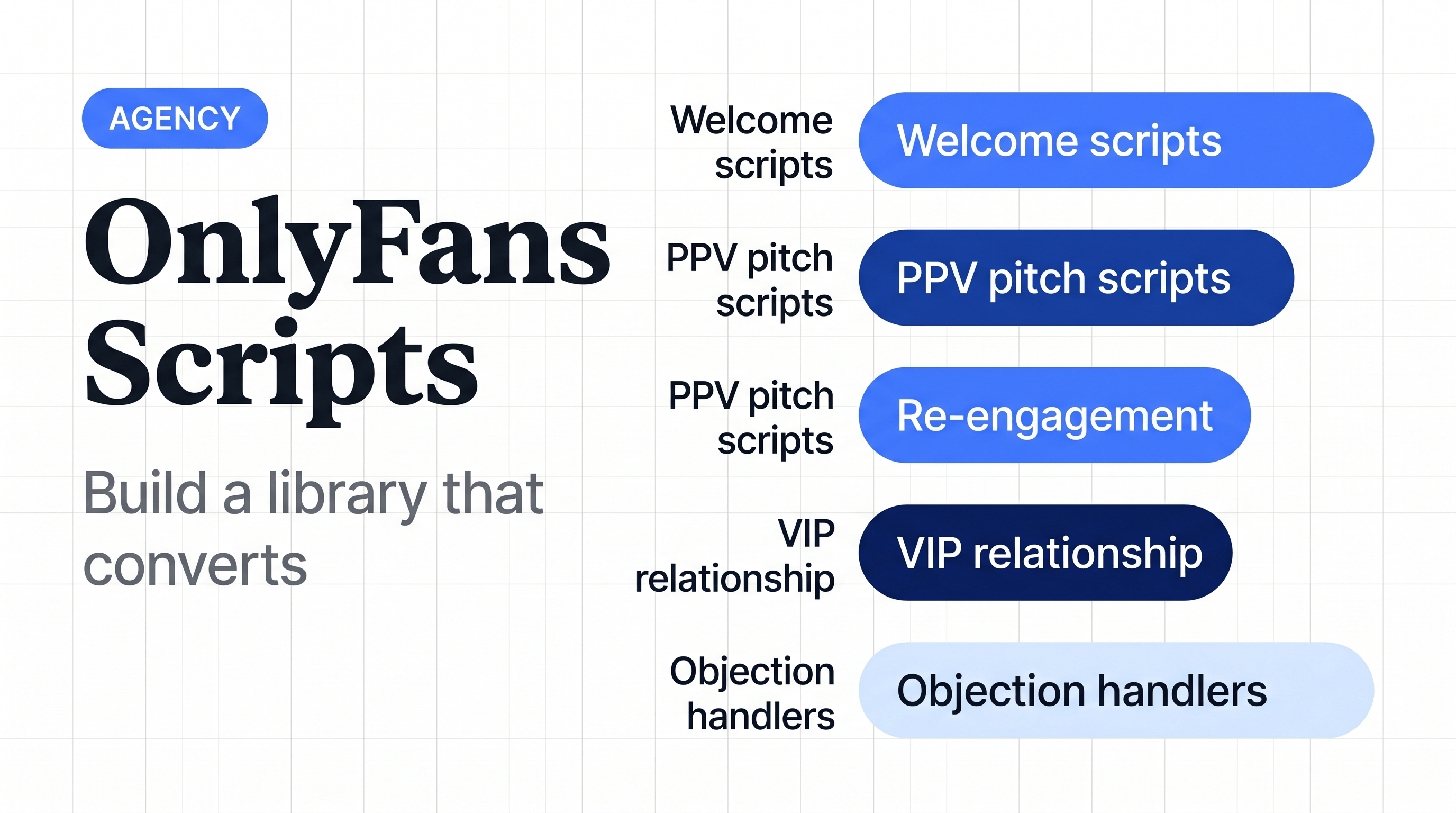
A complete script library covers five distinct scenario types, each serving a different function in the fan revenue lifecycle.
Welcome scripts are the first impression. A subscriber's first message determines whether they make a purchase in the first 48 hours — which is the highest-leverage conversion window in the fan lifecycle. The welcome script needs to accomplish three things simultaneously: establish the creator's voice and personality, qualify the fan's interests in a way that feels like conversation rather than interrogation, and create a natural opening for the first PPV pitch within the first two to three exchanges. Most agencies either skip the qualification step (sending generic welcomes that don't learn anything about the fan) or skip the pitch (building rapport but missing the conversion window). The best welcome scripts do both.
PPV pitch scripts are the core revenue-generating sequences. A well-written PPV pitch creates desire for specific content before revealing the price, frames the price relative to the value rather than as a cost, and includes a natural objection handler for the most common pushbacks. The most important variable in a PPV script is timing — the pitch should arrive when a fan's engagement signal is strongest, not on a fixed schedule. Scripts that account for timing context (pitching when a fan has just engaged with a piece of content, for example) consistently outperform those that don't.
Re-engagement scripts target fans who have gone quiet. The critical mistake most agencies make with re-engagement is using the same script regardless of why the fan went quiet. A fan who purchased last week and hasn't messaged since needs a completely different approach than a fan who subscribed six weeks ago and has never purchased. The re-engagement script library should have separate sequences for at minimum: recent purchasers who've gone quiet, active fans who've stopped buying, and cold subscribers who've never converted. Each sequence needs a different hook, different offer, and different call to action.
VIP relationship scripts are for your highest-value fans and require more personalization than any other category. These scripts are frameworks more than fixed sequences — they provide the structure for building and maintaining a high-spend relationship while leaving significant room for the human chatter to inject specific references to past conversations, expressed preferences, and individual personality. The purpose of VIP scripts is to ensure that even when chatters change, the relationship continuity is maintained through consistent tone and reference to documented fan history.
Objection handler scripts exist as a standalone category because objections are predictable. "That's too expensive," "I need to think about it," "I already have that content," "I'm not sure it's worth it" — these come up in almost every account every day. Having pre-built, tested responses to each common objection means chatters and AI never improvise their way through the moments that most often determine whether a sale closes or doesn't. The objection handler library should cover at minimum five to eight common pushbacks with two or three response variants for each.
How to Write Scripts That Actually Convert
The technical structure of a converting script follows a consistent pattern regardless of scenario type. Understanding this pattern makes writing new scripts significantly faster and the outputs more reliable.
Every converting script opens with something that acknowledges the fan's specific context rather than starting with the seller's agenda. A welcome script that opens with a reference to how the fan found the creator is more engaging than one that opens with a generic greeting. A re-engagement script that references the fan's last interaction is more effective than one that opens with "hey, we miss you." The opening line sets the tone for whether the fan feels like an individual or a number.
The middle section of any converting script builds desire before it creates the opportunity to purchase. For PPV pitches, this means establishing what the fan will get — the feeling, the content type, the specific scenario — before mentioning price. For re-engagement, it means rebuilding connection before presenting an offer. For welcome sequences, it means genuinely qualifying the fan's interests before pitching anything. The conversion logic is consistent: desire precedes offer, always.
The close should be confident and specific. Vague closes — "let me know if you're interested" or "what do you think?" — produce vague results. Specific closes — "I just locked a video for you at $25, it unlocks in the next 24 hours" — convert at higher rates because they create a clear, bounded decision rather than an open-ended one.
Organizing Your Script Library for Agency Use
A script library that isn't organized properly doesn't get used. Chatters under pressure during a shift will default to improvisation rather than searching through a disorganized document for the right sequence. The organizational structure needs to make finding the right script faster than making something up.
The most effective organization structure uses a three-level hierarchy: scenario type at the top level (welcome, PPV, re-engagement, VIP, objection handlers), fan segment at the second level (Newbie, Spender, VIP for each scenario type), and script variant at the third level (two to three versions of each script to avoid repetition across conversations). This means a chatter managing a VIP fan re-engagement situation can navigate directly to VIP re-engagement scripts rather than scrolling through the entire library.
Naming conventions matter significantly at scale. A script labeled "RE-ENG-VIP-01" is findable in a way that one labeled "script for when a high spender goes quiet" is not. Standardizing naming before the library grows makes the difference between a resource that gets used and one that gets ignored.
Version control is underrated. Scripts improve over time as you learn what converts and what doesn't. Maintaining a changelog — noting which version replaced which, and what performance data drove the change — means your script evolution is documented rather than arbitrary, and new chatters can understand why the current version exists.
How AI Uses Your Script Library
For agencies running AI chatbots, the script library is the direct input that determines AI performance. This is worth understanding precisely because it changes how you invest in script quality.
A well-configured AI chatbot like Substy's executes scripts as the foundation of every conversation, adapting them to each fan's history and behavioral signals. The AI doesn't improvise — it selects the most appropriate script from the library based on the fan's classification, their conversation context, and the behavioral triggers you've defined, then personalizes it against that specific fan's data. A fan who spent $80 last month gets a different script selection than a fan who has never purchased, automatically, without a chatter having to decide.
This means that improving your script library directly and immediately improves AI performance. A better PPV pitch script translates to a higher AI conversion rate. A better re-engagement sequence translates to more cold fans returning. There's no interpretation layer between the script and the output — the AI executes the logic you've written, at scale, across every conversation simultaneously.
The practical implication is that script quality is the highest-ROI investment available to agencies using AI automation. Time spent improving scripts produces compounding returns because every improvement is applied across every AI-managed conversation from that point forward. The AI playbook for OnlyFans agencies covers how to configure the AI to deploy scripts optimally, but the quality of the scripts themselves is what determines whether the configuration produces strong results or mediocre ones.
Testing and Improving Your Scripts Over Time
A script library that doesn't evolve based on performance data isn't a professional asset — it's a static document. The agencies with the best-performing script libraries are running systematic tests and making data-driven updates on a regular cadence.
The metrics that indicate a script needs improvement are specific. A welcome script with a low first-purchase rate within 48 hours is underperforming on qualification or pitch timing. A PPV script with a high send volume but low conversion rate has a problem with desire-building, pricing, or close specificity. A re-engagement script that isn't improving open rates has a hook problem. Each underperformance metric points to a specific script element to test.
A/B testing scripts at the agency level — running variant A on some accounts and variant B on others for two to four weeks, then comparing conversion metrics — produces reliable data on what actually works rather than what seems like it should work. Most agencies find that their intuitions about which scripts will perform best are wrong at least 30% to 40% of the time, which is precisely why testing matters.
The chatter performance analytics available through a proper CRM make this testing systematic rather than anecdotal. When you can see exactly which chatter, using which script, on which fan segment, produced which conversion rate — you have the data to improve with precision.
Script Libraries for Fanvue vs OnlyFans
The same script library principles apply on Fanvue, with adjustments for the platform's audience dynamics. Fanvue fans have a longer initial qualification window before first purchase, which means welcome scripts need to invest more in relationship-building before the first PPV pitch. They also respond more strongly to niche-specific language, which means the personalization layer of every script needs to reference the creator's specific content positioning more explicitly than a comparable OnlyFans script might.
PPV pricing language in Fanvue scripts can anchor higher than OnlyFans equivalents because of Fanvue's higher average fan spending intent. The objection handlers for Fanvue are also slightly different — the most common pushbacks on Fanvue skew toward value questions rather than pure price sensitivity, which means the objection handler scripts need to emphasize content quality and exclusivity rather than pricing flexibility.
Agencies managing both platforms benefit from maintaining platform-specific script variants rather than forcing the same library to work across both. The core structure is the same — the personalization layer and pricing anchors differ. The Fanvue vs OnlyFans comparison covers the audience dynamics that drive these differences in more detail.
FAQ - OnlyFans Script Writing
What should an OnlyFans welcome script include ?
A strong welcome script should open with a reference to how the fan found the creator, qualify their content preferences through conversational questions rather than a form-style interrogation, and create a natural opening for a first PPV pitch within the first two to three exchanges. It should sound like the creator — matching their established voice and tone — rather than like a generic greeting.
How many scripts does an agency need ?
A complete script library for a professional agency operation typically contains 40 to 80 individual scripts — two to three variants each across the five core categories (welcome, PPV pitch, re-engagement, VIP, objection handlers), segmented by fan tier. Smaller operations can function with 20 to 30 scripts and expand as they learn what their specific audience responds to.
How do you write a PPV pitch that doesn't feel pushy ?
The key is building desire before introducing the offer. Establish what the fan will experience — the specific content type, the scenario, the emotional payoff — before mentioning price or that it's locked. When the price arrives after genuine desire has been created, it registers as an opportunity rather than a sales pitch. Combining this with a specific, time-bounded close produces the best conversion rates.
Should scripts be the same for all fans ?
No — scripts should be segmented by fan tier at minimum. A Newbie fan who has never purchased needs a lower-price entry-point pitch and a longer qualification sequence. A Spender who has bought before responds better to direct pitches referencing their purchase history. A VIP fan expects personalized references to your shared history and responds poorly to generic sequences. The same script sent to all three fan types will underperform for all three.
How often should scripts be updated ?
A review cycle of every four to six weeks is standard for active agency operations. Scripts that are underperforming on key metrics — low conversion, low open rates on re-engagement — should be tested immediately rather than waiting for the review cycle. Scripts that are performing well should be documented carefully before any updates so the performing version is preserved.
Can AI write OnlyFans scripts ?
AI can generate script drafts that provide useful starting points, especially for common scenarios. The drafts typically require editing for voice consistency, accurate pricing configuration, and specific objection handling relevant to your creator's audience. For agencies building a script library from scratch, AI-generated drafts with human refinement is significantly faster than writing from zero — but human review and testing is essential before deploying scripts in live conversations.
The Bottom Line
A script library is the operational asset that turns individual chatter skill into consistent agency output. It's the difference between an operation where performance depends on who's on shift and one where every conversation — human or AI — works from a tested, improving foundation.
Building it properly takes real investment upfront. Maintaining it requires systematic testing and regular updates based on performance data. But the compounding returns — better conversion rates, more consistent fan experiences, faster AI performance improvements — make it one of the highest-ROI investments any agency can make.
Substy centralizes script management alongside fan data, AI chatbot deployment, and chatter analytics in one platform — so the library you build is immediately available to both your human team and your AI, across every account you manage.