
OnlyFans Chatter Performance — How to Measure and Improve Your Team
The complete guide to OnlyFans chatter performance — the 5 metrics that matter, how to read performance patterns, the coaching framework that actually improves results, and how AI performance compares.
Most OnlyFans agencies manage their chat team by feel. They know roughly who their best chatter is, they have a sense of who's been underperforming, and they have occasional conversations about quality when something goes obviously wrong. What they don't have is a system that tells them exactly what each chatter is generating, where the gaps are, and what to do about them.
The agencies consistently generating the most revenue per account are the ones that have replaced gut feel with data. They know their chatter performance numbers the way a sales manager knows their team's conversion rates — and they use those numbers to make decisions that compound over time.
This guide covers exactly what to measure, how to interpret it, and what to do when the numbers reveal a problem.
Why Chatter Performance Measurement Is Non-Negotiable at Scale
When you have one chatter managing one account, performance is visible. You can see the conversations, you know the revenue, and you have a reasonable sense of whether things are going well.
When you have six chatters managing twelve accounts across multiple shifts, visibility collapses. The chatter who seems engaged in team messages might be producing half the revenue of a quieter colleague who just executes. A chatter who's been on the team for a year might have quietly developed bad habits that are costing you thousands of dollars a month in unrealized PPV revenue. A new hire might be genuinely outperforming veterans — but without data, you have no way to know.
Performance measurement solves this visibility problem. It makes the actual output of every team member transparent, accountable, and comparable — which changes how people work when they know their numbers are tracked. Most chatters perform noticeably differently when they understand that their results are measured, visible, and tied to their compensation and standing on the team.
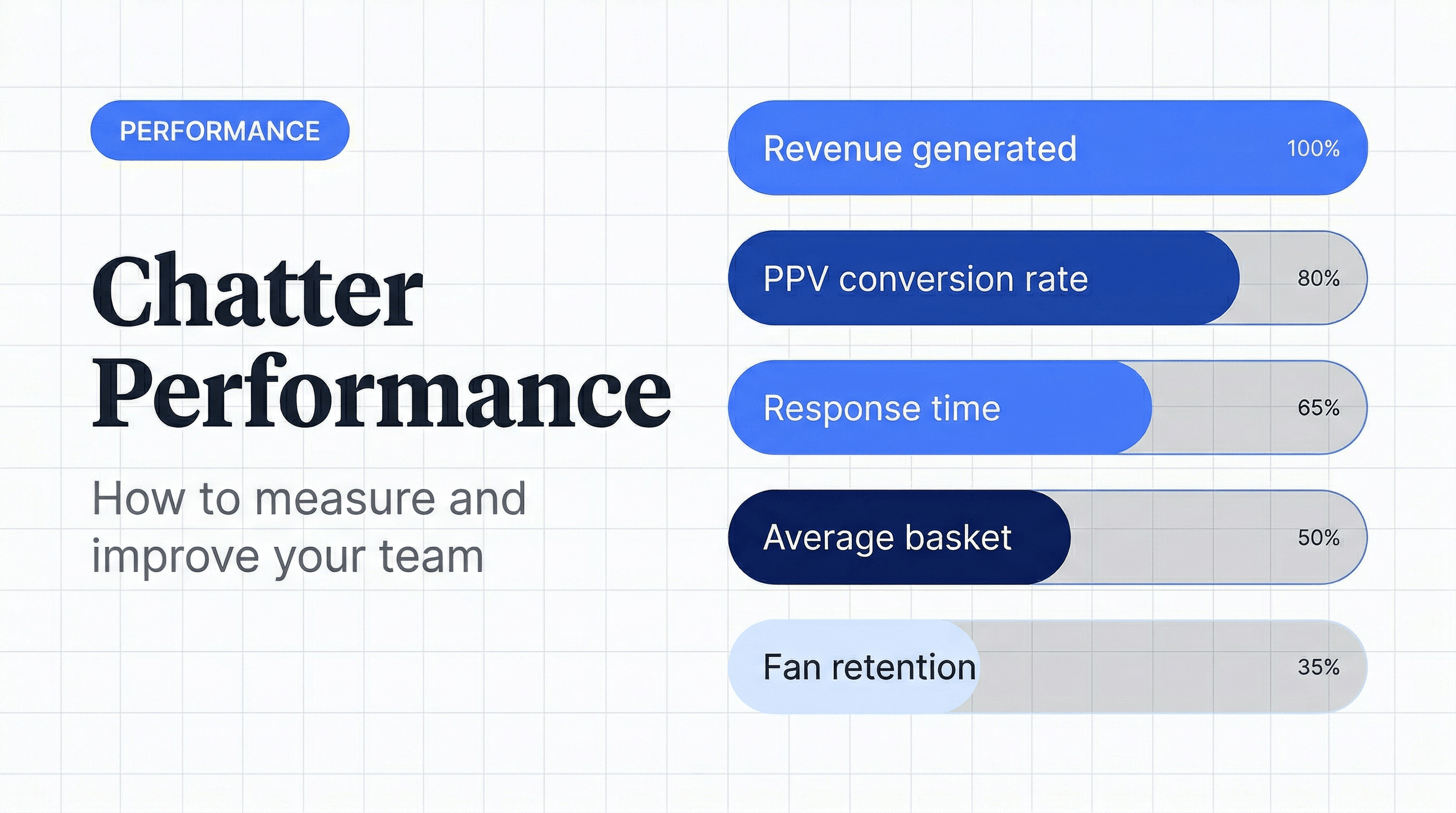
The 5 Metrics That Actually Matter
There are dozens of data points you could track across a chat team. These five are the ones that drive decisions.
Revenue generated per chatter is the headline number. How much did this person contribute to account revenue over the period — day, week, month ? This is the bottom line metric that everything else helps explain. A chatter with high revenue is valuable regardless of how they're achieving it. A chatter with low revenue needs to be understood before they can be improved.
PPV conversion rate reveals sales effectiveness independent of message volume. A chatter sending 300 messages a day with a 4% PPV conversion rate is producing less value than one sending 150 messages with a 12% rate. The conversion rate tells you whether the chatter is actually closing or just filling an inbox. It should be tracked both overall and by fan segment — because a chatter with a high overall rate but a weak VIP conversion rate has a specific skill gap that's very different from one with the opposite profile.
Response time has a measurable impact on fan satisfaction and conversion. Fans who receive quick responses convert better and churn less. A chatter who regularly takes 20 to 30 minutes to respond to fans who messaged first is leaving money on the table on every shift they work. Average response time per chatter, tracked over time, tells you whether someone has the pace the role requires.
Average basket per fan tells you whether a chatter is pricing correctly. Two chatters with identical PPV conversion rates but different average baskets are generating very different revenue. A chatter who consistently sells at the lower end of the pricing range is either misconfigured on pricing guidelines or lacks the confidence to hold price on fans who would pay more. This metric surfaces that problem explicitly.
Fan retention rate by chatter is the most lagging indicator but one of the most important for long-term agency economics. If fans managed by a specific chatter are churning at a higher rate than those managed by others, that chatter is damaging the subscriber base even if their short-term revenue numbers look acceptable. Tracking 30-day and 60-day retention per chatter identifies this before it becomes a significant problem.
How to Read the Numbers - What Each Pattern Tells You
Raw metrics are only useful when you know how to interpret them. These are the patterns that show up most commonly and what they mean.
High revenue, low conversion rate means a chatter is generating results through volume rather than skill — they're sending enough messages that even a low conversion rate produces significant revenue. This is sustainable as long as they maintain the volume, but it suggests untapped upside. If their conversion rate could be brought up to team average through coaching, their already-strong revenue output would increase further.
Low revenue, high conversion rate means a chatter is skilled at closing but not generating enough opportunities to close. The issue is usually message volume or fan selection — they're not pitching enough or they're spending time on fans who aren't likely to buy. The fix is behavioral coaching on volume and fan prioritization, not sales technique.
Good revenue, slow response time means a chatter who is effective when they do engage but whose slow response is likely costing them additional revenue that faster engagement would capture. This is one of the easiest performance gaps to address because the fix is behavioral rather than skill-based.
Strong conversion rate on regular fans, weak conversion on VIPs is the pattern that shows up most in agencies that haven't specifically trained their chatters for high-ticket closes. The chatter can sell standard PPV effectively but doesn't have the technique or confidence to manage the longer, more relationship-driven conversations that drive large individual purchases from VIP fans. This is where targeted coaching or reallocation — putting this chatter on lower-tier fans and reassigning VIPs to a stronger closer — makes a direct revenue impact.
Declining retention over time, otherwise stable metrics is the pattern that's hardest to spot without tracking it explicitly. A chatter who is producing consistent revenue but whose fans are churning faster than average is borrowing against future revenue. They're likely burning through fan goodwill — over-pitching, ignoring signals, or delivering inconsistent quality — in a way that doesn't show up in short-term numbers but will eventually reduce the account's subscriber base. The subscriber retention guide covers how to diagnose and fix the underlying causes.
The Coaching Framework That Actually Improves Performance
Identifying performance gaps is half the work. The other half is closing them through coaching that actually changes behavior.
The mistake most agency owners make is having a vague "you need to do better" conversation that produces no specific action and no measurable change. Effective performance coaching is specific, data-driven, and tied to concrete experiments with defined evaluation windows.
A good coaching conversation looks like this: "Your PPV conversion rate on Newbie fans is 4%. The team average is 9%. I've pulled three conversations from your last shift where a Newbie fan didn't convert, and I want to look at them with you. Here's what I notice about the pitch timing in each one..." That conversation has a specific problem, a data reference, concrete examples, and a path to diagnosis.
The improvement action should be equally specific: "For the next week, I want you to try sending the first PPV within the first three messages rather than waiting for the fan to engage more. We'll compare your Newbie conversion rate at the end of the week against this week's baseline." A defined experiment with a defined evaluation window makes it possible to know whether the coaching actually worked.
Script library access is one of the most underleveraged coaching tools available. If a chatter's conversion rate on re-engagement sequences is weak, showing them the exact sequence your best-performing chatter uses for the same scenario — and letting them adapt it — is more efficient than any abstract conversation about technique. The hiring and training guide covers how script libraries should be structured to support this kind of lateral learning across the team.
How AI Performance Compares to Human Chatter Performance
One of the most valuable things a proper analytics system reveals is the comparison between what your AI is generating and what your human chatters are generating on the same accounts.
Most agencies that implement AI automation and track the comparison properly are surprised by what they see. The AI consistently outperforms human chatters on response time (no comparison), re-engagement rate for cold fans (AI never forgets to follow up), and revenue per message on lower-tier fans where the conversation is relatively templated. Human chatters outperform on VIP closes, custom negotiations, and situations requiring genuine emotional intelligence.
This data is what makes the hybrid model's resource allocation so precise. You're not guessing at where AI adds value — you're seeing it in the numbers. Agencies with clean AI vs human performance data can set their VIP thresholds much more precisely, because they know at exactly what fan spend level the human chatter's performance starts to exceed the AI's return on time invested. The AI playbook covers how to configure this handoff correctly once you have the data to calibrate it.
Setting Up the System - What You Need
None of this analysis is possible without the right infrastructure. Tracking chatter performance manually — pulling numbers from the native OnlyFans dashboard and matching them to individual team members through shift logs — is theoretically possible but practically unworkable at any meaningful scale.
A proper OnlyFans CRM handles all of this automatically. Every chatter logs into their assigned accounts through the platform, every conversation they have is attributed to their profile, and every sale they contribute generates a data point in their performance record. The analytics dashboard shows revenue, conversion rate, response time, and basket size per chatter, per account, per time period — without anyone having to compile anything manually.
The split inbox system also ensures that chatter attribution is accurate. When each chatter is assigned to specific fans through a structured routing system rather than all sharing access to the same inbox, there's no ambiguity about who handled which conversation and who deserves credit for which sale. This cleanliness of attribution is what makes the performance data actionable rather than approximate.
FAQ - OnlyFans Chatter Performance
What is a good PPV conversion rate for an OnlyFans chatter ?
Strong chatters typically achieve 10% to 18% PPV conversion rates on well-segmented fan bases. Below 6% generally indicates a technique or targeting problem worth investigating. The benchmark matters less than the trend — consistent improvement over time is the signal of a chatter who is developing, regardless of where they start.
How do you track chatter performance on OnlyFans ?
The native OnlyFans dashboard doesn't provide per-chatter analytics. Professional agencies use a CRM platform like Substy that attributes every sale, message, and fan interaction to the chatter who handled it, generating automatic performance reports per team member per account.
How often should you review chatter performance ?
Revenue and response time should be reviewed daily for active operations. PPV conversion rate and average basket should be reviewed weekly. Fan retention should be reviewed monthly. Performance conversations with individual chatters should happen at 30, 60, and 90 days for new hires and monthly for established team members.
What do you do if a chatter's performance is declining ?
Before having a performance conversation, pull the data and identify the specific metric that has changed. A decline in conversion rate needs a different conversation than a decline in response time or retention. Once the specific gap is identified, look at recent conversations to find concrete examples, build a specific improvement action with a defined evaluation window, and review at the end of that window.
Should AI performance be tracked alongside human chatter performance ?
Yes, and this comparison often generates the most valuable operational insights available to an agency. Knowing exactly where AI outperforms human chatters and where humans outperform AI allows precise calibration of the hybrid routing model — and makes the case for AI investment with actual data rather than estimates.
How does chatter performance connect to agency profitability ?
Directly. Revenue per chatter determines how much each team member contributes relative to their cost. A chatter earning $2,500 a month who generates $8,000 in agency revenue share produces very different economics than one generating $3,500. Tracking this ratio per chatter is how agencies identify their highest-ROI team members — and decide where to invest in development versus where to make changes.
The Bottom Line
Chatter performance management is the operational discipline that separates agencies running a professional operation from those running an expensive inbox. The metrics exist, the patterns are predictable, and the coaching that improves performance is straightforward once you have the data to base it on.
The agencies consistently outperforming their competition on revenue per account are almost always the ones that have made performance data visible, accountability genuine, and coaching specific. None of that requires exceptional management instinct — it requires the right system and the discipline to use it.
Substy makes all of this automatic — per-chatter analytics, split inbox attribution, AI vs human performance comparison, and real-time dashboards that give agency owners the visibility they need to manage a team that actually improves over time.