Why Your OnlyFans Chatbot Is Burning Out Your Best Fans
Why AI chatbot automation burns out your best OnlyFans fans over time - the 5 failure modes, how to fix routing, and why VIP fan retention requires human attention that most agencies aren’t providing.
There's a pattern that shows up in agency data consistently enough to be worth taking seriously. An account with a high-quality AI chatbot running full automation sees strong PPV conversion in months one and two. By month four or five, open rates are declining, tip revenue is dropping, and the best fans — the ones who were spending $200 a month — are going cold or canceling. The automation is still running. The messages are still going out. But something has changed.
What changed is that the fans figured it out. Not necessarily that they can prove it's a bot — but they stopped believing in the relationship. And once that belief is gone, the revenue goes with it.
This is the problem nobody talks about when they sell you on AI chatbot automation. It's real, it's predictable, and it's avoidable if you set things up correctly from the start.
Why High-Value Fans Are Different
Not all OnlyFans fans are equally susceptible to automation fatigue. The mass of subscribers in the low-to-mid spending tier — fans who buy PPV occasionally and renew their subscription monthly — can be managed effectively by a well-configured AI indefinitely. Their expectations are modest: good content, occasional engagement, reasonable response times. AI meets these expectations without strain.
VIP fans are categorically different. The fan spending $300 or $500 a month isn't paying for content. They're paying for the feeling that they matter specifically to this creator. They're paying for a relationship that feels personal, remembered, and real. The moment that feeling breaks — and it breaks the moment they sense they're talking to a system rather than a person — the commercial logic of the relationship collapses. They don't downgrade to casual spending. They leave.
The irony is that VIP fans are often the most attuned to the signals that distinguish genuine human interaction from AI output. They've been talking to this creator (or the chatter behind the creator) for months. They notice when the response style shifts. They notice when context from previous conversations disappears. They notice when messages arrive at oddly regular intervals regardless of what time they sent their message. They don't necessarily say anything — they just gradually disengage, tip less, spend less, and eventually stop renewing.
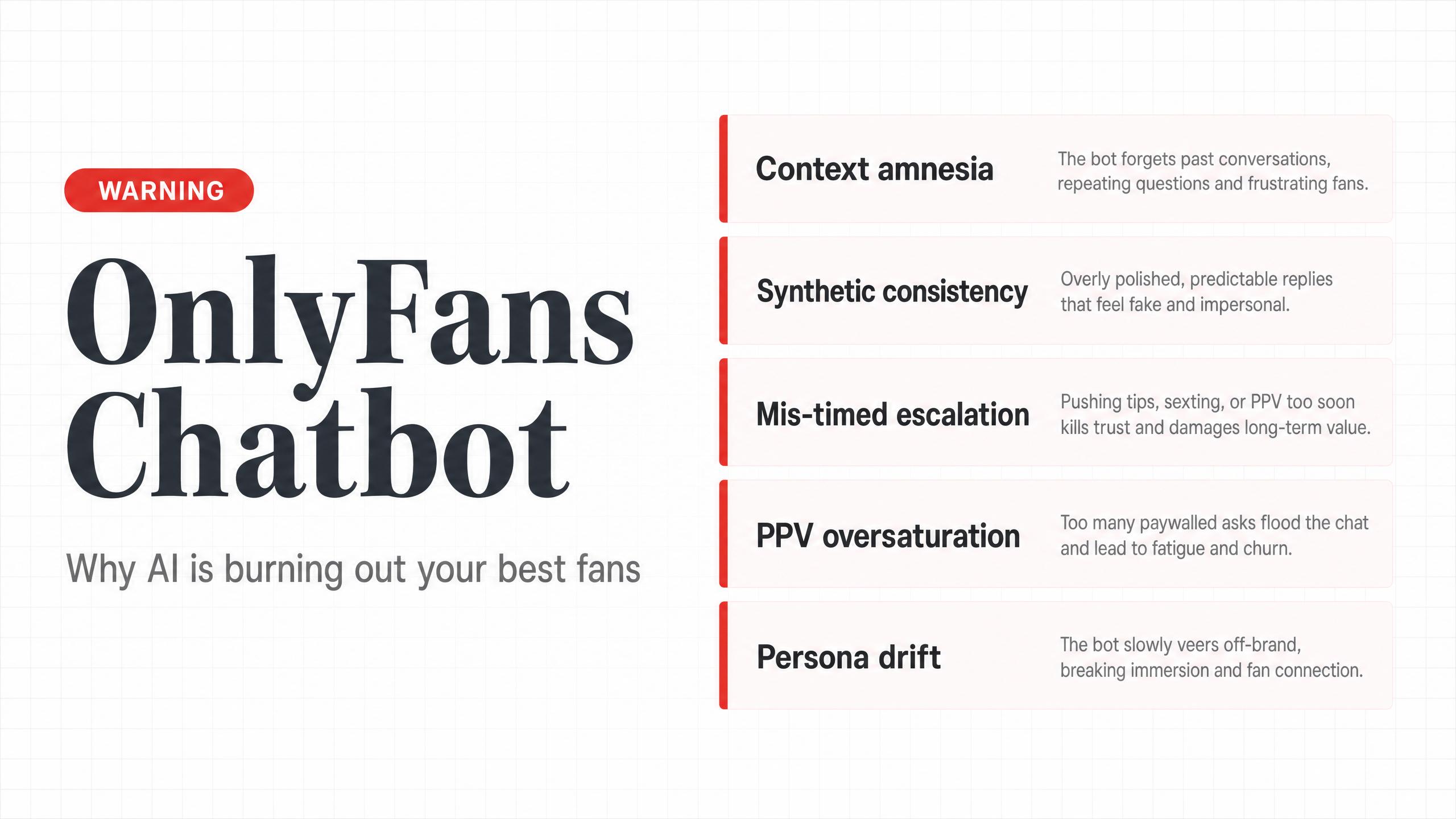
The 5 Ways AI Chatbots Burn Out Best Fans
Context amnesia. The single most damaging AI chatbot failure mode is forgetting what happened in previous conversations. A fan who mentioned their job, their trip, their dog last week and receives no acknowledgment of any of it this week starts to realize they're not actually remembered. Real relationships involve memory. AI chatbots without deep conversation history integration simulate memory badly or not at all. Even sophisticated language models lose context when conversation windows reset. The fan doesn't know the technical reason. They just feel forgotten.
Synthetic consistency. Human chatters have off days. They have moments of genuine enthusiasm. They have conversational variation that feels alive. AI generates text at a consistent quality and tone level that, over time, reads as uniformly processed rather than genuinely engaged. High-value fans who interact frequently enough build a pattern recognition for AI-level consistency that eventually registers as cold rather than professional.
Mis-timed escalations. A well-configured AI routes VIP fans to human chatters above a spending threshold. But the routing often happens too late — after the fan has already started disengaging — or the transition is handled poorly, creating a jarring shift in conversational tone that confirms the fan's suspicion that the previous interaction wasn't human. The transition needs to be invisible to the fan. In most implementations, it isn't.
PPV oversaturation. AI chatbots optimized for PPV conversion will send offers when the signal is right. Over time, fans who receive a steady cadence of PPV pitches — even well-targeted ones — start to feel like customers rather than fans. The relational framing that made them comfortable spending disappears under the weight of transactional messaging. The best fans spend because they want to, not because they're being sold to. AI that doesn't modulate commercial frequency based on relationship depth runs this risk systematically.
Persona drift. AI persona configurations erode under real conversational pressure. Unusual fan messages, emotionally complex interactions, topics outside the configured scenarios — these all create moments where the AI produces responses that don't quite fit the creator's voice. Each of these small misses accumulates. The fan's internal model of who they're talking to gradually diverges from what they're receiving, which creates a low-level dissonance that eventually breaks the relationship.
The Fix Is Not Less Automation - It's Better Routing
The answer to AI chatbot burnout is not to reduce automation. It's to be more precise about which conversations AI should handle and which it shouldn't.
The fan who subscribed last week and has never bought PPV content should be fully AI-managed. The fan who has spent $600 in the last 90 days should have a human closer involved, at minimum for the conversations that carry real relationship weight. The threshold between these two categories needs to be defined explicitly and acted on automatically by the platform's routing logic.
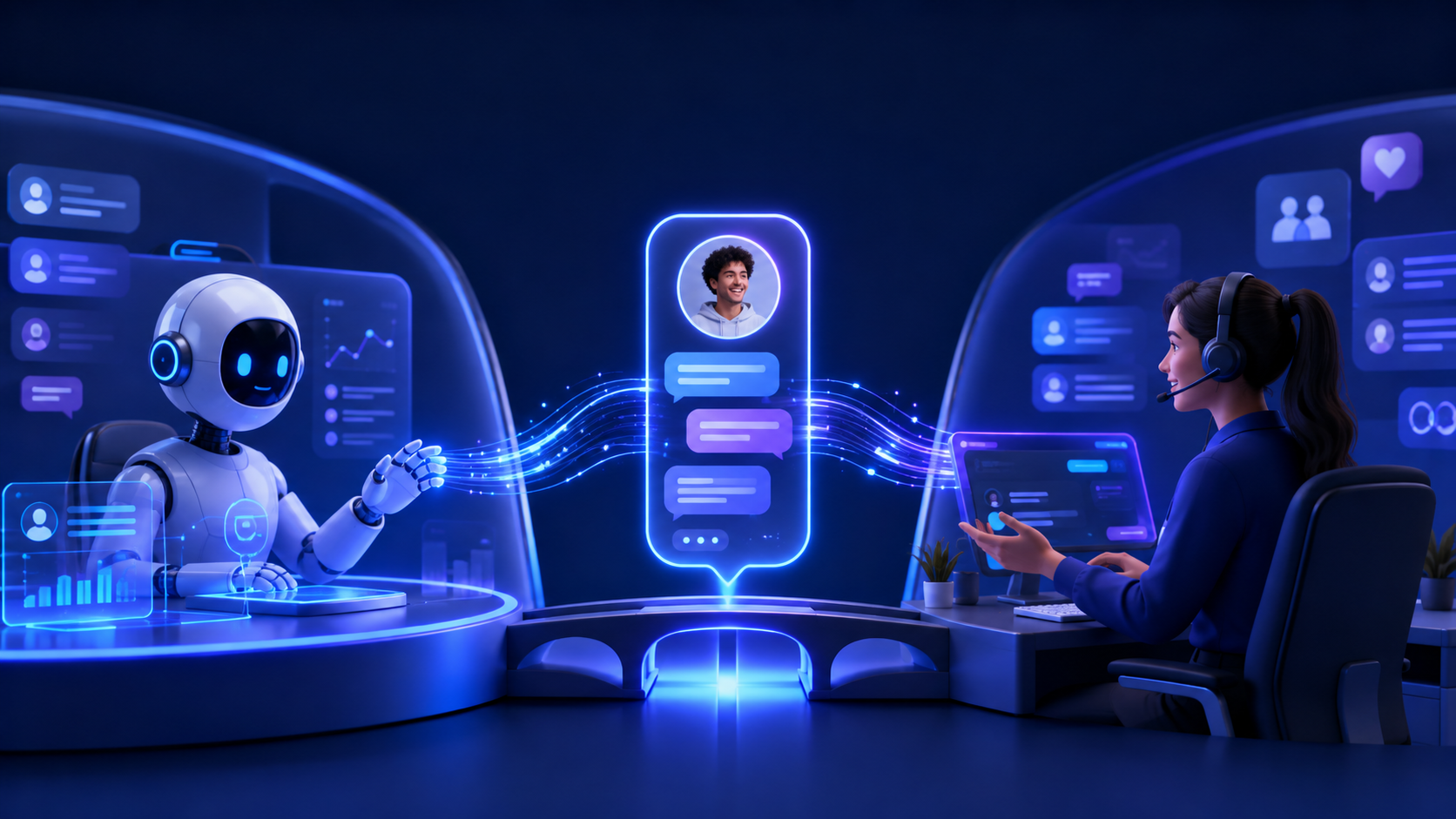
This is the core of the hybrid model that the most successful agencies run: AI handles the volume, humans handle the value. The ratio varies by operation, but the principle is consistent. AI is infrastructure for scale. Humans are infrastructure for depth. Neither works optimally without the other.
The routing needs to be automatic, not manual. An agency relying on chatters to identify and flag VIP relationships for human attention is creating a process that fails at scale and under pressure. A properly configured CRM with fan classification that automatically routes fans above a spending or engagement threshold to human chatters is the operational foundation that makes the hybrid model work without constant oversight. The complete framework for building this infrastructure is in the guide to using AI for OnlyFans agencies.
What Good AI Chatbot Behavior Actually Looks Like
The AI chatbots that don't burn out best fans have a few things in common. They have genuine conversation memory — not just within a session but across sessions, with persistent fan context that follows the relationship over time. They have commercial frequency controls that prevent PPV oversaturation for fans who are already high-engagement relationships. They have persona configurations that are detailed enough to handle edge cases without breaking character. And they have escalation logic that triggers early — before a VIP fan shows disengagement signals, not after.
The bar for AI chatbot behavior at the high end of the fan relationship is different from the bar at the low end. A AI-generated welcome message for a new subscriber doesn't need to be indistinguishable from human writing — it needs to be fast, warm, and effective. An AI managing a six-month relationship with a fan who has spent $800 needs a much higher standard of contextual coherence, persona consistency, and commercial restraint.
Most AI chatbot implementations don't differentiate between these requirements. They run the same configuration across all fans, which works acceptably at the low end and fails predictably at the high end. The configuration that prevents VIP burnout is the one that applies different rules to different fan tiers automatically.
The Cost of Getting This Wrong
The economics of VIP fan churn are not symmetric with the economics of regular subscriber churn. Losing a $10-a-month subscriber who was buying occasional PPV costs maybe $15 to $25 in monthly revenue. Losing a $400-a-month VIP fan costs $400 in monthly revenue plus the compounding loss of a relationship that was likely to continue spending for months or years. Agencies that underinvest in VIP relationship management while over-automating the entire fan base are making an expensive trade-off that doesn't show up obviously in monthly revenue until the VIP attrition rate starts to compound.
The fan management framework that tracks per-fan revenue over time — rather than just monthly totals — is what makes this dynamic visible before it becomes a revenue problem. Knowing that your top ten fans by spend have collectively reduced their monthly contributions by 30% over the last quarter is a signal that needs to be acted on. Knowing that this reduction correlates with the month you upgraded to full automation is the insight that explains it. Neither signal is available without proper per-fan analytics. The metrics framework that surfaces this data is covered in the OnlyFans metrics guide.
FAQ - OnlyFans Chatbot and Fan Burnout
Can fans tell when they're talking to an OnlyFans chatbot ?
Not always, and not immediately. Most fans don't consciously identify AI responses as AI. What they experience is a gradual erosion of the relational feeling that makes them willing to spend. High-spending VIP fans are more sensitive to this than casual subscribers, because their spending is more dependent on feeling genuinely valued rather than entertained by content.
Does using an AI chatbot reduce OnlyFans revenue over time ?
Poorly configured AI chatbot automation can reduce VIP fan retention over time, which reduces revenue from the highest-value segment of the subscriber base. Well-configured automation — with proper fan classification, routing, and VIP-specific conversation controls — maintains or improves overall revenue by handling volume efficiently while protecting high-value relationships with human attention.
How do you know if your OnlyFans chatbot is hurting your best fans ?
Track per-fan revenue month over month for your top 10% of spenders. If their individual spending is declining while overall account revenue is stable or growing from new subscribers, you have a VIP retention problem. The cause is almost always insufficient human attention to high-value relationships, often masked by AI-driven volume metrics that look healthy.
What percentage of OnlyFans fans should be human-managed vs AI-managed ?
By count, typically 90% or more of fans can be AI-managed effectively. By revenue, the top 20% of fans by spend should have meaningful human chatter involvement in their relationship management. The exact thresholds depend on the account's fan base composition and the agency's capacity, but the principle — AI for volume, humans for depth — is consistent across high-performing operations.
How do you transition a fan from AI to human management without them noticing ?
The transition needs to maintain conversational continuity — the human chatter needs full access to the fan's conversation history and context before engaging. The persona and tone should remain consistent with what the fan has experienced previously. The transition should happen proactively when a fan crosses a spending threshold, not reactively when they're already showing disengagement signals.
The Bottom Line
AI chatbots are infrastructure, not relationships. The agencies that treat them as a replacement for relationship management — rather than as a system for handling volume efficiently so that human relationship management is focused where it matters most — are the ones watching their best fans slowly disappear.
The solution is not less AI. It's better AI configuration, better fan classification, and better routing that gets the right conversation to the right handler at the right time. That infrastructure is what separates agencies that scale sustainably from those that grow fast and watch retention quietly collapse.
Substy is built for exactly this model — AI handling 90% of fan volume, fan classification that automatically routes VIPs to human closers, and per-fan analytics that make VIP attrition visible before it becomes a revenue problem.